

Microsoft has published a deep-dive mapping the end-to-end attack chain targeting Azure Blob Storage, detailing how threat actors abuse misconfigurations, credentials, and automation to exfiltrate data, persist, and even run covert command-and-control via blob metadata channels. The guidance urges customers to enable Microsoft Defender for Storage, tighten SAS token practices, disable anonymous public access, and lock down networking with private endpoints and firewalls to cut risk across AI, analytics, backup, and other data-heavy workloads.
What happened
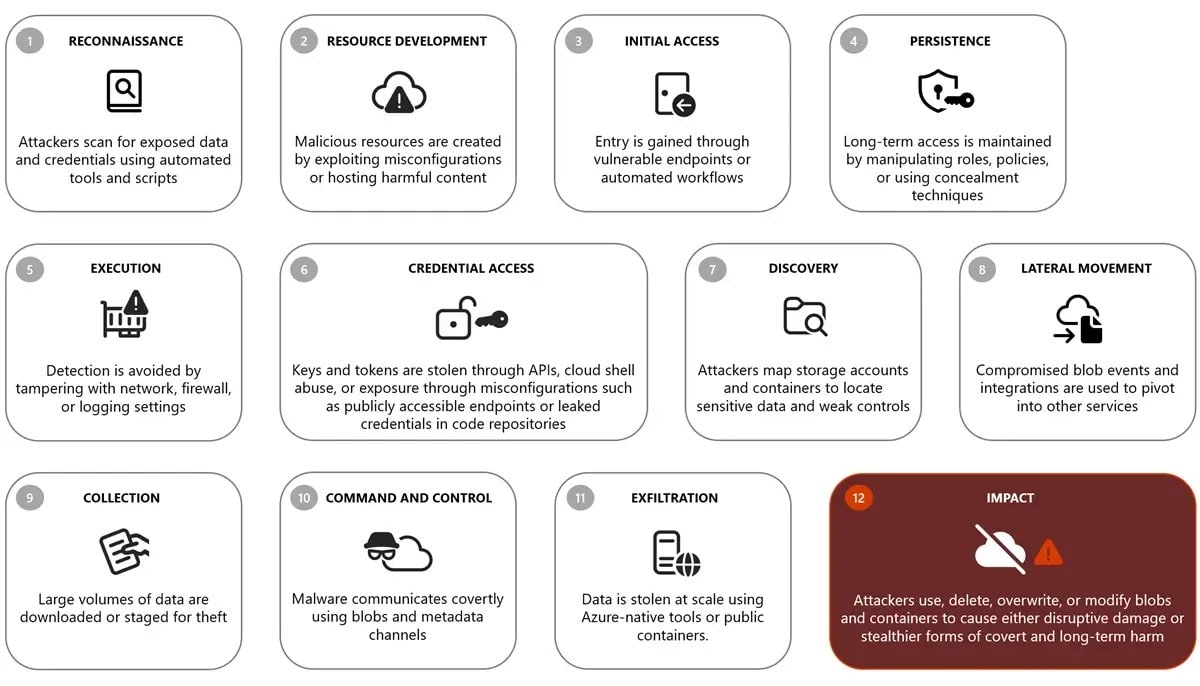
Microsoft Threat Intelligence outlined how adversaries target Azure Blob Storage across every stage of the attack chain, from reconnaissance and initial access to exfiltration and impact, mapping techniques to MITRE ATT&CK and tying them to concrete Azure security controls. The post emphasizes that Blob Storage underpins AI, HPC, analytics, media delivery, backups, and IoT ingestion, making it a high‑value target where misconfigurations or weak access controls can harm data integrity and business continuity at scale.
How attacks work
-
Reconnaissance: actors enumerate *.blob.core.windows.net subdomains, use tools like Goblob and QuickAZ, and increasingly leverage language models to guess storage names, while scraping repos for SAS tokens, account keys, or Entra credentials to gain footholds.
-
Resource development and initial access: Blob Storage is abused to host spoofed sign-in pages and malware, or to trigger misconfigured Azure Functions/Logic Apps via blob events for downstream compromise.
-
Persistence and evasion: adversaries mint broad, long-lived SAS, flip containers to allow anonymous reads, enable SFTP, tamper with firewall/VNet rules, or disable diagnostics to outlast key rotations and hide activity.
-
Lateral movement and collection: crafted blobs can pivot through Event Grid–triggered workflows running under elevated identities, while misconfigured containers enable mass listing and copying of sensitive data via Azure-native tools and APIs.
-
Command-and-control and exfiltration: malware can poll blob metadata for instructions, use object replication for distribution, or expose data via the static website $web container and trusted Azure bandwidth to evade detection.
Why Azure Blob Storage attack chain matters
The same scale and flexibility that make Blob Storage ideal for AI datasets, analytics lakes, enterprise backups, and media delivery also make it attractive for staging malware, phishing, and data theft if identity, network, and data protections lag behind attacker tradecraft. Microsoft notes that static website hosting’s $web container is always public, so disabling anonymous access at the account level does not protect content moved there, underscoring the need for defense-in-depth and workload-aware controls.
Microsoft’s guidance
-
Enable Microsoft Defender for Storage for activity monitoring, sensitive data threat detection, and near real-time malware scanning, and deploy at scale via policy for consistent coverage and alerting.
-
Monitor and remediate Storage security recommendations in Defender for Cloud to track baseline drift and configuration weaknesses across subscriptions and accounts.
-
Prefer managed identities/RBAC over shared credentials, and if using SAS, apply least privilege, short expirations, and user delegation SAS to reduce blast radius from leaks or abuse.
-
Disable anonymous public access at the account level where possible and avoid hosting sensitive content in containers intended for public scenarios.
-
Lock down networking with Storage firewalls and Azure Private Endpoints to keep traffic on the Microsoft backbone and reduce public exposure paths.
-
Use immutability, soft delete, versioning, and backup integrations to limit impact from tampering, deletion, or ransomware-style re-encryption.
Detections and alerts
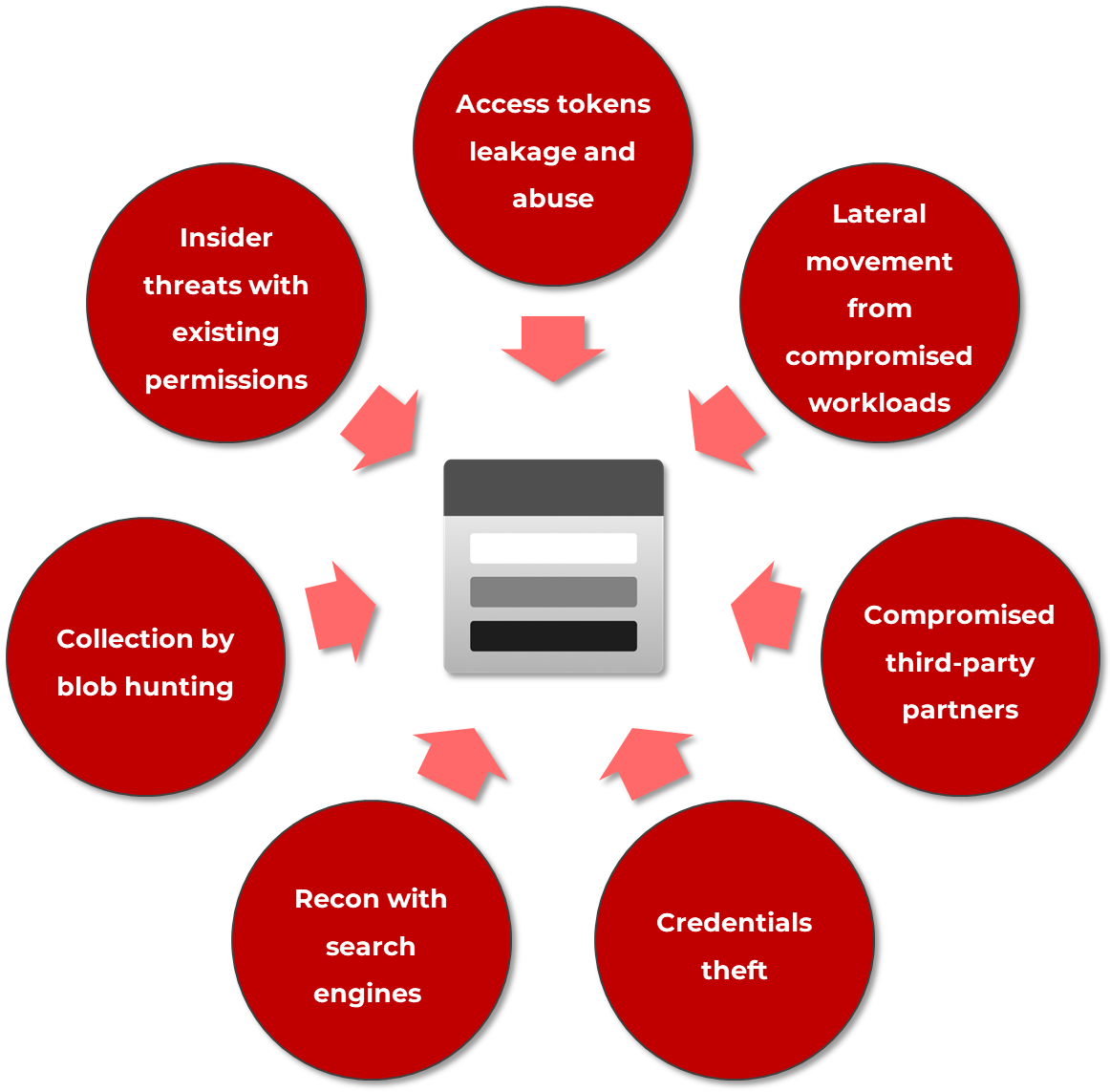
Microsoft lists numerous Defender for Storage alerts aligned to the attack chain, including unusual public access to sensitive containers, suspicious or overly permissive SAS usage, malware uploads, and anomalous data extractions at scale. Defender for Cloud’s threat coverage analyzes data/control plane telemetry to flag reconnaissance, resource development, command-and-control behaviors, and exfil patterns without requiring diagnostic logs, complementing malware scanning and sensitive data signals.
Important things to keep top of mind
-
Audit and eliminate public containers that don’t serve a clear business purpose, and enforce account-level anonymous access settings consistently across environments.
-
Inventory and rotate account keys, enumerate SAS issuance, and replace long-lived or overly broad SAS with short-lived, scoped, user delegation SAS backed by Entra RBAC.
-
Gate storage traffic with Private Endpoints and firewalls, then monitor for rule drift or unauthorized endpoint creation that could open covert access channels.
-
Enable Defender for Storage with malware scanning and sensitive data threat detection, and integrate alerts with SIEM/SOAR to automate triage and response.
-
Treat Blob-backed automations as potential pivot points by reviewing Event Grid triggers, Functions/Logic Apps identities, and pipeline trust boundaries to prevent file-triggered lateral movement.
The bottom line
Blob Storage is now a full battleground where identity, network, data, and monitoring controls must work together, and Microsoft’s latest guidance translates attacker TTPs into concrete steps teams can implement today. Start by turning on Defender for Storage, tightening SAS and public access, and isolating storage with private networking to reduce exposure while gaining detections across the entire attack chain.
Discover more from Microsoft News Now
Subscribe to get the latest posts sent to your email.
