

Microsoft has unveiled Maia 200, a new inference‑focused AI accelerator built from the ground up to slash the cost and boost the throughput of AI token generation at cloud scale. The announcement, detailed in a January 26, 2026 blog post by Scott Guthrie, Executive Vice President of Cloud + AI, positions Maia 200 as the most performant first‑party silicon any hyperscaler has deployed to date—and a key pillar of Microsoft’s multi‑generation AI hardware strategy.
For enterprise customers, developers, and Microsoft‑centric shops, Maia 200 is more than just another chip: it’s a signal that Microsoft is betting big on custom silicon, low‑precision compute, and tightly integrated Azure services to make Copilot‑style experiences cheaper, faster, and more scalable than ever before.
What Maia 200 Actually Is
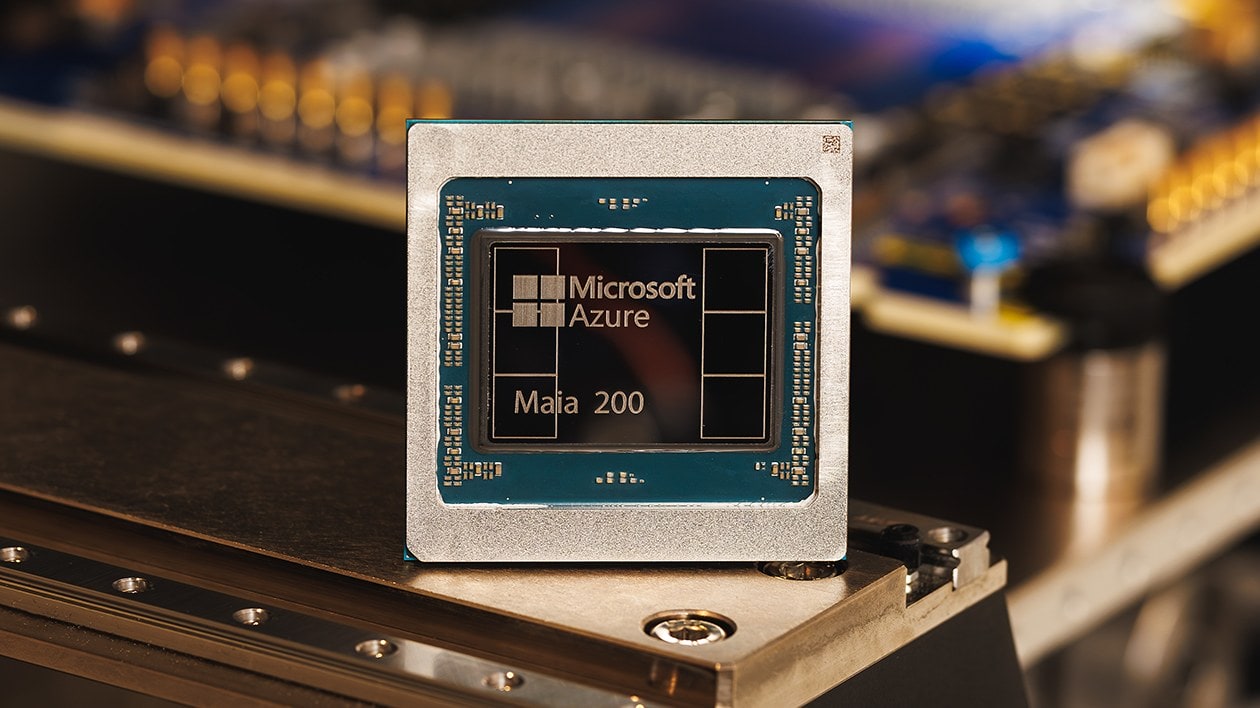
At its core, Maia 200 is an AI inference accelerator engineered specifically for running large‑scale models in production, not for training. Fabricated on TSMC’s 3‑nanometer process, each Maia 200 die packs over 140 billion transistors and is tuned for the kinds of transformer‑heavy workloads that underpin today’s LLMs and AI agents.
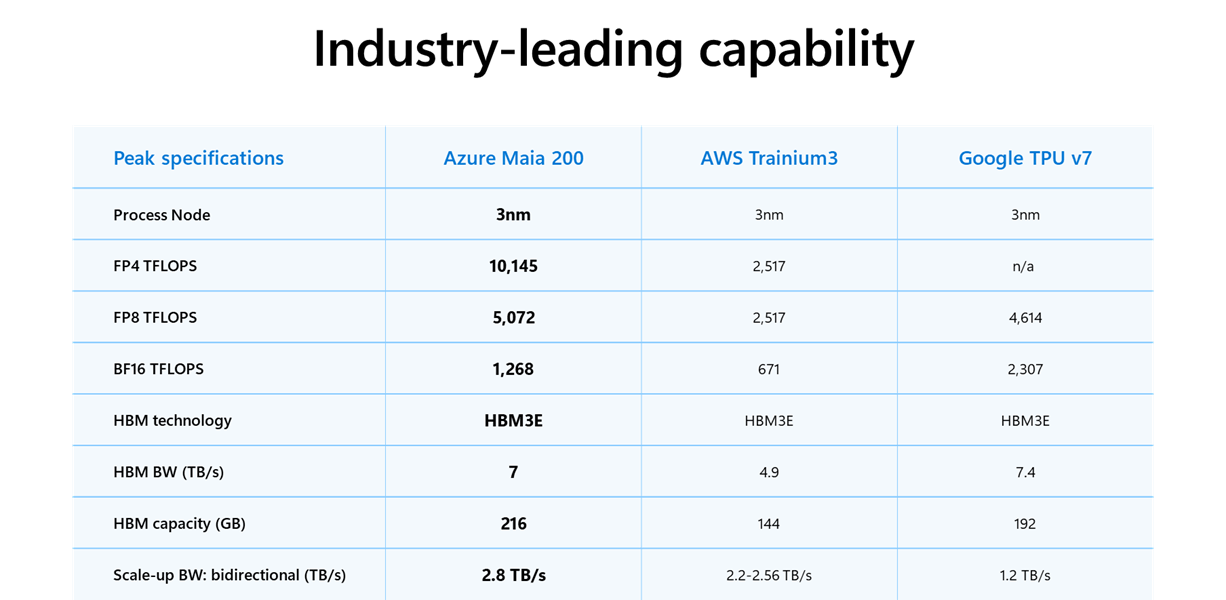
Microsoft touts three headline specs that define its “inference‑first” philosophy:
-
Native FP8/FP4 tensor cores for low‑precision compute.
-
A redesigned memory subsystem with 216GB HBM3e at 7 TB/s bandwidth and 272MB of on‑chip SRAM.
-
Data‑movement engines and NoC fabric that keep models fed with data at high utilization.

In practical terms, Microsoft claims Maia 200 delivers over 10 petaFLOPS in 4‑bit (FP4) precision and over 5 petaFLOPS in 8‑bit (FP8), all within a 750W SoC TDP envelope. That combination of raw throughput, narrow‑precision support, and power‑efficient design is what allows Microsoft to say Maia 200 is the most efficient inference system it has ever deployed, with roughly 30% better performance per dollar than the latest hardware in its current fleet.
Why “Inference‑First” Matters
Historically, most AI hardware headlines have been about training: bigger GPUs, more VRAM, and exotic interconnects for multi‑week training runs. Maia 200 flips that script.
For Microsoft, the real business bottleneck is inference economics—how cheaply and quickly it can serve trillions of AI tokens per day for Copilot, Microsoft 365, Azure AI, and OpenAI models. Every millisecond of latency and every watt of power saved translates directly into lower TCO and higher margins at hyperscale.
Maia 200 is designed around that reality. By optimizing for low‑precision FP8/FP4 inference, Microsoft can run large models with higher throughput and lower energy consumption than general‑purpose GPUs tuned for mixed training/inference workloads. The 216GB HBM3e stack and 272MB SRAM are tuned to keep the tensor cores saturated, reducing stalls and maximizing token‑per‑second output.
In Microsoft’s own benchmarking, Maia 200 is said to deliver three times the FP4 performance of Amazon’s third‑generation Trainium and FP8 performance above Google’s seventh‑generation TPU, making it the most performant first‑party silicon from any hyperscaler.
Where Maia 200 Fits in Microsoft’s AI Stack
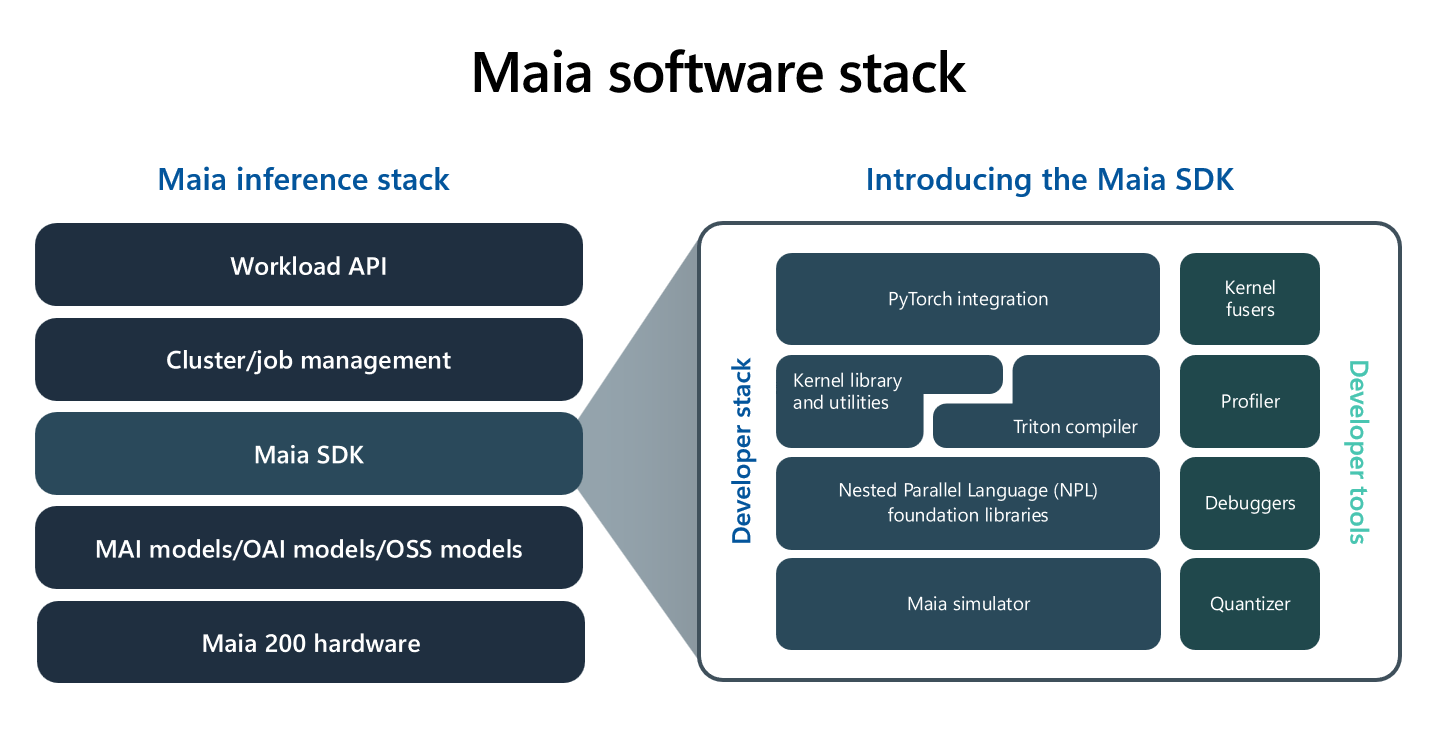
Maia 200 isn’t a standalone product; it’s a first‑class citizen inside Microsoft’s heterogeneous AI infrastructure, sitting alongside GPUs, other custom accelerators, and Azure’s software stack.
Microsoft says Maia 200 will serve multiple models, including the latest GPT‑5.2 models from OpenAI, which are already being used in Microsoft Foundry and Microsoft 365 Copilot. For enterprise customers, that means Copilot‑driven experiences—writing, coding, summarizing, and agentic workflows—could become cheaper, faster, and more responsive over time as Maia‑backed capacity scales.
The Microsoft Superintelligence team will also use Maia 200 for synthetic data generation and reinforcement learning to improve next‑generation in‑house models. In synthetic‑data pipelines, Maia’s architecture accelerates how quickly high‑quality, domain‑specific data can be generated and filtered, feeding downstream training jobs with fresher, more targeted signals.
System‑Level Design: Two‑Tier Networking and Unified Fabric
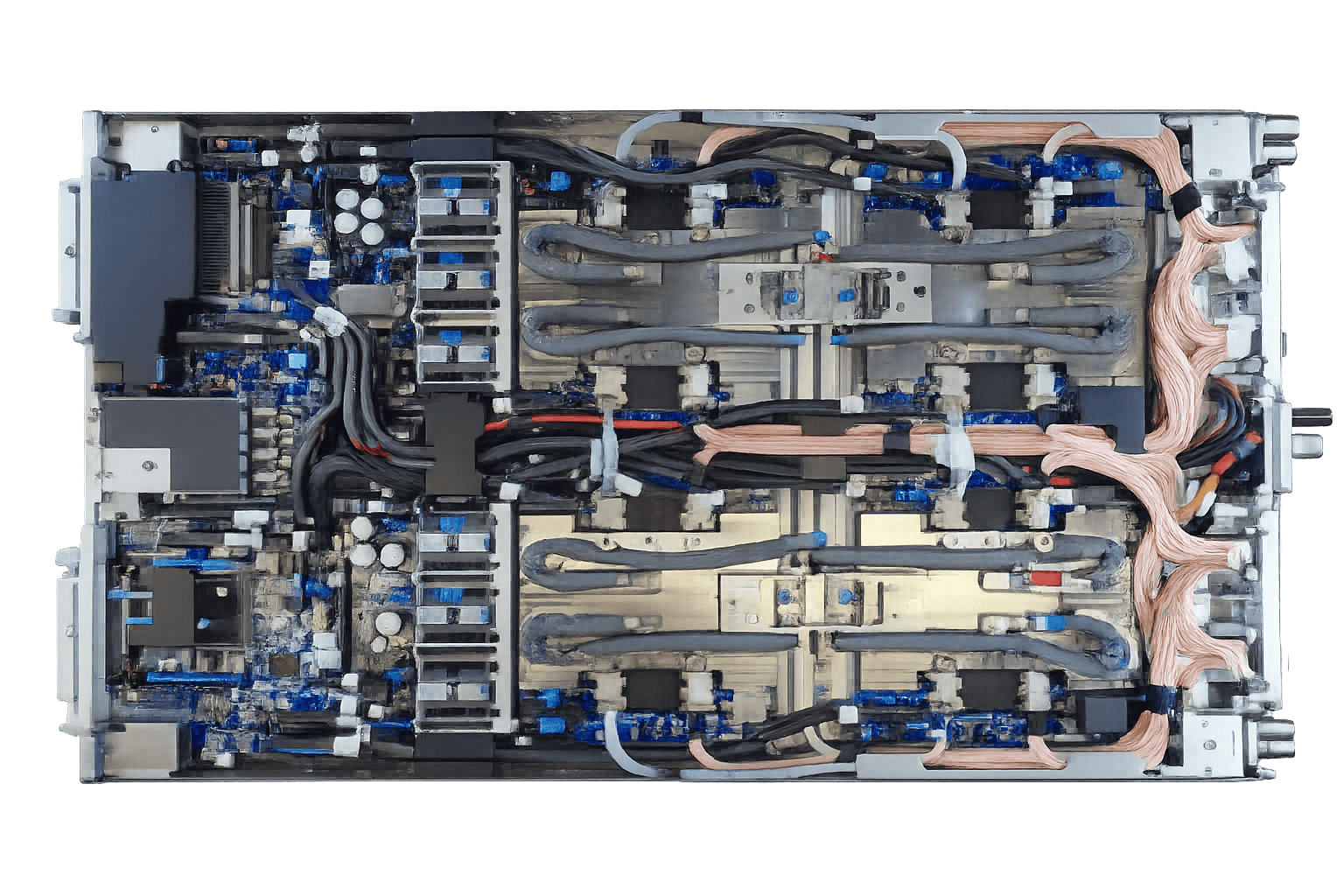
At the rack and cluster level, Maia 200 introduces a novel two‑tier scale‑up network built on standard Ethernet, with a custom transport layer and tightly integrated NIC to unlock high‑performance, reliable communication without relying on proprietary fabrics.
Each Maia accelerator exposes 2.8 TB/s of bidirectional, dedicated scale‑up bandwidth, enabling predictable, high‑performance collective operations across clusters of up to 6,144 accelerators. Within each tray, four Maia accelerators are fully connected with direct, non‑switched links, keeping high‑bandwidth communication local for optimal inference efficiency.

The same communication protocols are reused for intra‑rack and inter‑rack networking via the Maia AI transport protocol, allowing seamless scaling across nodes, racks, and clusters with minimal network hops. That unified fabric simplifies programming, improves workload flexibility, and reduces stranded capacity while maintaining consistent performance and cost efficiency at cloud scale.
From Chip to Cloud: A “Cloud‑Native” Development Approach

One of the more interesting aspects of Maia 200 is how early Microsoft baked end‑to‑end validation into the design process.
Microsoft used a sophisticated pre‑silicon environment to model LLM computation and communication patterns with high fidelity, allowing the team to optimize silicon, networking, and system software as a unified whole long before first silicon arrived. That co‑development approach helped shrink the time from first packaged part to first datacenter rack deployment to less than half that of comparable AI infrastructure programs.
Maia 200 is also designed for fast, seamless deployment in the datacenter, with early validation of complex system elements like the backend network and Microsoft’s second‑generation, closed‑loop, liquid‑cooling Heat Exchanger Unit. Native integration with the Azure control plane delivers security, telemetry, diagnostics, and management capabilities at both the chip and rack levels, maximizing reliability and uptime for production‑critical AI workloads.
Deployment and Availability
Maia 200 is already deployed in Microsoft’s US Central datacenter region near Des Moines, Iowa, with US West 3 near Phoenix, Arizona coming next and additional regions planned to follow. That phased rollout lets Microsoft stress‑test the hardware in real‑world Copilot, Foundry, and internal Superintelligence workloads before expanding globally.
For developers and partners, Microsoft is previewing the Maia SDK, which includes:
-
PyTorch integration for familiar model development.
-
A Triton compiler and optimized kernel library for high‑performance inference.
-
Access to Maia’s low‑level programming language (NPL) for fine‑grained control.
-
A Maia simulator and cost calculator to optimize efficiency early in the development cycle.
Microsoft is inviting developers, AI startups, and academics to sign up for the Maia 200 SDK preview and start exploring model and workload optimization on this new architecture.
Competitive Context: Taking Aim at Amazon and Google
By positioning Maia 200 as the most performant first‑party silicon from any hyperscaler, Microsoft is clearly signaling its intent to compete head‑on with Amazon’s Trainium and Google’s TPUs in the inference‑heavy cloud AI market.
Claims of three times the FP4 performance of Amazon Trainium and FP8 performance above Google TPU v7 are designed to appeal to enterprises looking to reduce AI inference costs without sacrificing latency or scale. For Azure‑centric customers already invested in Microsoft 365, Copilot, and Azure AI, Maia 200 could become a default inference target for future‑facing AI workloads.
What This Means for Your Organization
If you’re running or planning to run Copilot‑enabled workloads, Azure AI services, or custom LLM deployments on Microsoft Foundry, Maia 200 is likely to show up as an under‑the‑hood efficiency boost rather than a flashy new SKU.
Over time, you can expect:
-
Lower cost per AI token for Copilot and Azure AI services.
-
Higher throughput and lower latency for large‑model inference.
-
Better scalability for synthetic‑data and reinforcement‑learning pipelines tied to Microsoft’s internal models.
For developers, the Maia SDK preview is worth watching closely. Early access to PyTorch integration, Triton compilation, and low‑level tools could give you a head start in optimizing models for this new inference‑first architecture before it becomes broadly available across Azure regions.
Get more photos, video and resources on our Maia 200 site and read more details.
Final Thoughts
Maia 200 is more than just another AI chip; it’s a strategic statement about how Microsoft plans to win the long‑term AI infrastructure game. By focusing on inference economics, custom silicon, and tight Azure integration, Microsoft is betting that the future of AI isn’t just about bigger models, but about running them cheaper, faster, and at planetary scale.
Recent Posts You Might Like
- The Windows 11 January Update Nightmare Continues: Boot Loops, UNMOUNTABLE_BOOT_VOLUME Error And Second Emergency Patch
- A Microsoft BitLocker Privacy Storm: How FBI Access to Encryption Keys Exposes a Major Windows Security Risk
- Next Week on Xbox (Jan 26–30): Highguard, Code Vein II, Front Mission 3 Remake, and a Quieter but Wilder Lineup
- Powerful VS Code Becomes First AI Code Editor to Give MCP Agents a Visual Voice with MCP Apps
- Security Copilot Now Included in Microsoft 365 E5 as Copilot Business Brings Advanced AI to SMBs
Discover more from Microsoft News Now
Subscribe to get the latest posts sent to your email.
