

Microsoft pushes “Frontier Transformation” with Microsoft 365 Copilot Wave 3
Microsoft is kicking off a major new phase for its AI strategy at work with the launch of “Wave 3” of Microsoft 365 Copilot, a broad update that deeply embeds agentic AI across Word, Excel, PowerPoint, Outlook, and Copilot Chat. The company is positioning this as a move from AI “experiments” to durable, enterprise-wide transformation, where copilots and agents become part of how everyday work actually gets done. Jared Spataro, Chief Marketing Officer, AI at Work, framed this shift around two pillars: intelligence and trust—AI that is contextually smart, and AI that organizations can safely scale.
In a new Microsoft 365 blog post, Spataro lays out how these announcements are intended to turn AI from a sidecar tool into a core operating layer for modern organizations. The idea is that AI must not only optimize existing workflows, but also unlock new ways of working, grounded in real data and governed by enterprise-grade security and compliance.
Copilot Cowork and agentic capabilities move from demo to reality
At the center of Wave 3 is the evolution from simple, prompt-response interactions to agentic behavior—long-running, multi-step work that spans multiple apps and persists over time. Copilot Cowork, which Microsoft is bringing into Microsoft 365 Copilot in partnership with Anthropic’s Claude technology, allows users to delegate complex tasks that unfold over minutes or hours, rather than single-turn prompts. Cowork breaks down requests into steps, reasons across Outlook, Teams, Excel, and files, and carries the work forward while keeping users in the loop with visible progress and checkpoints.
This long-running execution is powered by Work IQ, Microsoft’s intelligence layer that understands the full context of your work instead of isolated data fragments. That means Copilot can update existing documents, refine spreadsheets with real formulas, build on-brand PowerPoint decks, and draft or refine emails directly in Outlook—all from within the apps where users already work. Microsoft says these enhanced Copilot experiences are now generally available in Word and Excel, with PowerPoint and Outlook rolling out over the coming months.
Agents in Copilot Chat become the new entry point
Not all work starts in a document, so Wave 3 makes Copilot Chat the primary entry point for “chat-first” creation and execution. From a single conversation, users can ask Copilot to create Word documents, Excel spreadsheets, and PowerPoint presentations, or take common actions like scheduling meetings and sending emails—without context switching between apps. Built-in agents for Word, Excel, PowerPoint, and Outlook can be invoked directly from chat, then seamlessly hand work off into the corresponding app for deeper editing and collaboration.
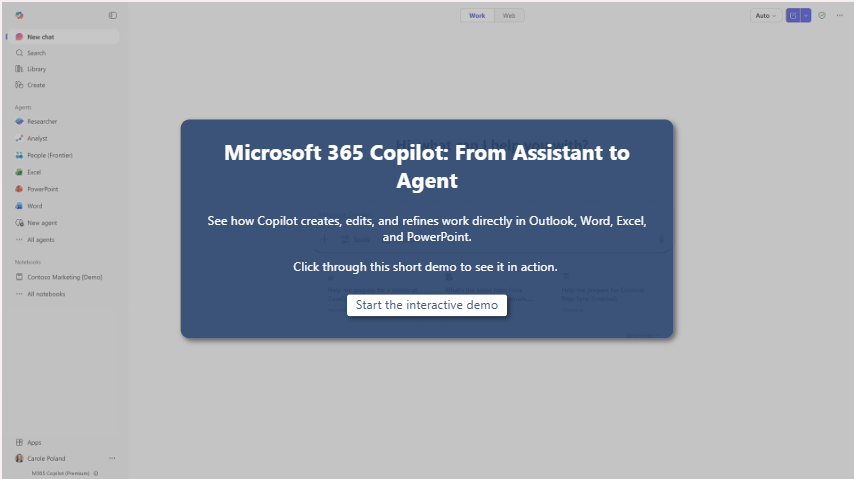
Crucially, Copilot Chat is also where the broader ecosystem plugs in. Agents built on open standards like the Apps SDK and MCP Apps can surface inside chat, bringing live, interactive experiences from Dynamics 365, custom Power Apps, and partner solutions such as Adobe, Monday.com, and Figma into a single conversational hub. Organizations can also build their own agents: frontline users can create lightweight helpers via Agent Builder, while IT and business teams can design more sophisticated process agents using Microsoft Copilot Studio, with new capabilities for evaluating agent quality, coordinating multiple agents, and enforcing governance.
Multi-model intelligence: Claude joins OpenAI models in Copilot
On the model side, Microsoft is doubling down on its multi-model approach. Instead of forcing customers to pick a single vendor or switch tools based on the task, Microsoft 365 Copilot now blends models from multiple providers under the hood. With Wave 3, Claude is becoming available in mainline Copilot chat via the Frontier program, alongside the latest generation of OpenAI models that continue to roll out into the service.
The key promise is that Copilot will automatically choose the right model for the job—whether that’s advanced reasoning, multi-step planning, or fast summarization—while keeping everything grounded in the user’s enterprise context and wrapped in Microsoft’s security and governance controls. For IT leaders, this aims to reduce tool sprawl and model fragmentation while still keeping pace with rapid innovation in the AI ecosystem.
Agent 365: A control plane for managing AI agents

As organizations spin up more agents across departments, Microsoft recognizes that the problem shifts from “Can we build agents?” to “How do we run them safely at scale?”. That’s where Agent 365 comes in. Described as the control plane for agents, Agent 365 gives IT and security teams a single place to observe, secure, and govern every AI agent across the organization.
Agent 365 extends familiar management concepts—like those already used for human identities—into the agent world. It integrates with Microsoft Admin Center and security tools such as Defender, Entra, and Purview, so teams can apply least-privilege access, enforce policies, and monitor agent activity without reinventing their entire stack. Microsoft says Agent 365 will be generally available on May 1, priced at 15 USD per user per month, setting a clear licensing model for AI agents as they become first-class entities in the enterprise.
Microsoft 365 E7: The Frontier Suite bundles AI, identity, and security
To bring all of this together in a single offering, Microsoft is introducing Microsoft 365 E7: The Frontier Suite. This new top-tier SKU is designed to pair AI and human productivity across the enterprise, bundling Microsoft 365 Copilot, Agent 365, Microsoft Entra Suite, and Microsoft 365 E5 with advanced Defender, Entra, Intune, and Purview security capabilities.

Microsoft 365 E7 will be available for purchase on May 1 at a retail price of 99 USD per user per month. The goal is to give enterprises a single package that unifies productivity, AI, identity, and security, while also delivering comprehensive protection for both users and agents. In Microsoft’s vision, this is what makes “Frontier Transformation” real: shared intelligence that understands context and history, combined with built-in trust so AI can scale without weakening security or compliance.
A turning point for AI at work
With Wave 3 of Microsoft 365 Copilot, Microsoft is clearly signaling that the age of standalone AI experiments is over. Agentic capabilities are now embedded in the core Microsoft 365 apps, Copilot Chat is evolving into a central hub for work, Agent 365 provides the control plane for managing AI agents, and Microsoft 365 E7 bundles it all into a single frontier-focused suite. For enterprises watching AI from the sidelines, these moves are likely to be a strong nudge: AI isn’t just an add-on anymore—it’s quickly becoming the way work happens across the Microsoft 365 ecosystem.
Recent Posts You Might Like
- March 2026 Microsoft 365 Changes: The Definitive Guide for IT Pros and SMB Admins
- The Big Windows 11 March 2026 Update Is Basically Locked In – Here’s What’s Coming On Patch Tuesday
- Xbox at GDC 2026: Microsoft’s Big Push to Help Devs Build What’s Next on Xbox and PC
- New (and Old) Games Dropping This Week on Xbox: March 8-14, 2026 – Fatal Frame, Monster Hunter, WWE 2K26 & More!
Discover more from Microsoft News Now
Subscribe to get the latest posts sent to your email.
