
If you logged into your work computer this Monday morning and ran into a wall trying to access your Microsoft apps, you aren’t imagining things — and you definitely aren’t alone. Microsoft is currently dealing with a significant Multi-Factor Authentication MFA outage affecting users across the United States, with 504 gateway timeout errors blocking access to a range of essential services including Azure, Microsoft 365, Outlook, and the Microsoft Store. The company confirmed the Microsoft MFA outage today publicly on Monday, February 23, 2026, and says it is actively investigating.
The outage, tracked internally by Microsoft as incident MO1237461, began at approximately 2:52 PM UTC (10:52 AM EST) on February 23, 2026 and has remained under active investigation as of the time of this writing. The timing — a Monday morning for most U.S. enterprise users — could not be worse, with workers across businesses large and small finding themselves locked out of core productivity tools at the start of the work week.
Microsoft MFA Outage Today: What Microsoft Is Saying
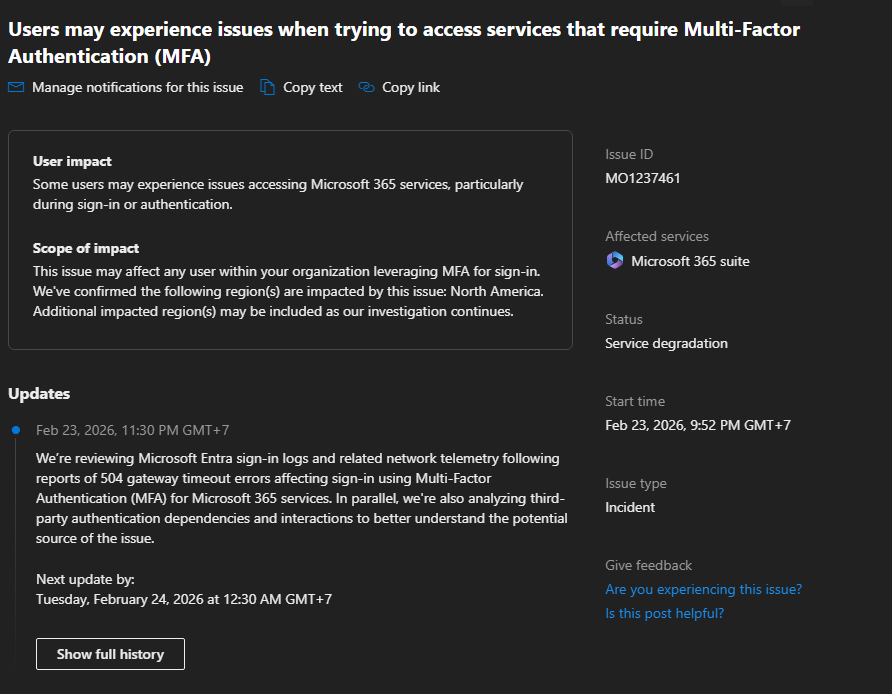
Microsoft was relatively quick to acknowledge the issue publicly, posting a statement on X (formerly Twitter) that confirmed the scope of the problem.
“We’re investigating an issue in which users in the United States may be experiencing 504 gateway timeout errors when trying to access services that require Multi-Factor Authentication (MFA),” the company stated.
The message was short on technical specifics but indicated that Microsoft’s engineering teams are actively working to identify the root cause and restore normal service. The company has not yet provided an estimated time for full resolution, which has left many IT administrators and end users frustrated. According to early reports from the sysadmin community, the issue appears to be rooted in Microsoft’s Entra ID (formerly Azure Active Directory) authentication layer. When users attempt to authenticate and the system invokes MFA — particularly through third-party authenticators like Duo Security — the request is timing out with a 504 Gateway Error, meaning the authentication server is failing to respond in time.
IT professionals on Reddit’s r/sysadmin community noticed the problem almost immediately after it began, with one user reporting: “Duo is functioning properly for all applications except for Azure AD federation, which seems to be causing issues. I suspect this is a Microsoft-related problem.” Others confirmed that the issue persists even after updating certificates, pointing to the problem being squarely on Microsoft’s infrastructure side rather than with any third-party tool.
Services Affected
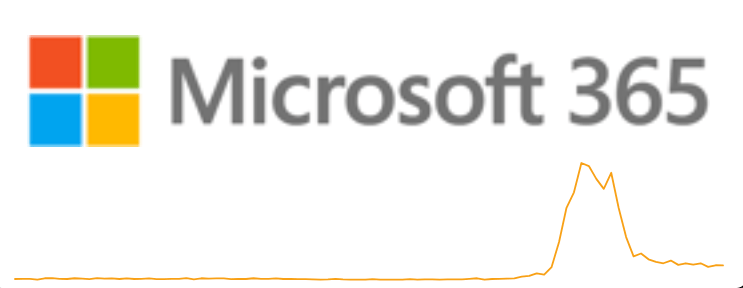
Service-tracking website Downdetector registered a notable spike in error reports shortly after the issue began, confirming the impact across multiple Microsoft products. The affected services include:
-
Microsoft Azure — cloud infrastructure and services timing out during MFA-protected logins
-
Microsoft 365 — enterprise productivity suite, including Word, Excel, PowerPoint, and Teams
-
Microsoft Outlook — both web-based and client-based email access disrupted
-
Microsoft Store — users unable to complete sign-in or app downloads requiring MFA
For enterprise organizations that rely on Microsoft 365 and Azure as the backbone of their daily operations, this type of authentication failure is essentially a full stoppage. Because MFA is now a security baseline requirement for most businesses — and is required by default across virtually all Microsoft commercial tenants — a failure in the MFA layer cascades into a broader inability to access services altogether.
Another Outage in a Rough Month for Microsoft
Today’s incident is unfortunately not an isolated event. Microsoft has had a rough stretch of service reliability in 2026. On January 22, the company suffered a nine-hour catastrophic outage that simultaneously knocked out Outlook, Exchange Online, Teams, SharePoint, OneDrive, Microsoft Defender, and Purview for users across North America — at its peak, Downdetector registered over 16,000 user reports in a matter of minutes. Microsoft attributed that failure to elevated service load resulting from reduced capacity during infrastructure maintenance, a situation where backup systems simply couldn’t carry the traffic weight of normal operations.
Then, in early February, Azure suffered back-to-back disruptions: a Virtual Machine management outage followed by a Managed Identity for Azure resources failure affecting the East US and West US regions for nearly six hours — the result of a cascading datacenter power failure involving a transformer failure and UPS battery depletion. GitHub, which is owned by Microsoft, also experienced degraded performance for GitHub Actions during that same window.
Now, today’s MFA incident is the latest entry in a growing list of reliability concerns for a company that is simultaneously asking enterprise customers to trust it with increasingly critical AI workloads.
The Impact on Microsoft Stock
Markets are taking notice. Microsoft (NASDAQ: MSFT) shares were down nearly 3% in Monday’s opening trading session as the outage news broke. That drop compounded an already difficult stretch for the stock. MSFT shares have declined more than 21% over the past six months, significantly underperforming the broader Nasdaq index. The stock is currently trading at approximately $397, having slipped from its 52-week high of $555.45 — a fall of more than 30% from peak.
The stock already took a beating in late January following a disappointing earnings report, triggering a 10% single-day drop and starting a five-session losing streak. Analysts from Zacks have noted that while Microsoft’s earnings estimates remain solid — with FY2026 EPS projected at $16.97, up 8.4% over the past 30 days — investor sentiment has grown cautious. The company’s commitment of $50 billion in AI infrastructure spending is raising serious questions about capital expenditure sustainability and near-term margin compression.
Today’s outage adds fresh fuel to investor concerns that Microsoft’s aggressive expansion into AI may be straining operational stability, particularly within its Azure cloud division — the very platform the company is counting on to monetize that AI investment.
Why Microsoft MFA Outages Are Uniquely Damaging
Not all outages are created equal. When a single app goes down — say, Outlook takes a few hours to recover — most organizations can work around it. But when the authentication layer fails, the impact is disproportionate. MFA sits at the entry point of virtually every Microsoft service in a modern enterprise environment. If a user can’t complete their MFA challenge, they can’t access any service behind that authentication wall — not their email, not their cloud files, not their business applications.
This is compounded by the fact that MFA adoption has skyrocketed across enterprise environments over the past few years. Microsoft itself has aggressively pushed MFA as a mandatory security baseline, and organizations in regulated industries like healthcare, finance, and government are required by compliance frameworks to enforce it. The same security architecture that protects organizations from credential-based attacks becomes a single point of failure when the underlying authentication infrastructure experiences an outage.
For IT teams managing this incident right now, the options are extremely limited. Bypassing MFA is not an acceptable solution in most environments, and the issue is outside the control of individual tenants — it sits squarely with Microsoft’s infrastructure.
What IT Admins Can Do Right Now
While Microsoft works on a fix, here are some practical steps for IT administrators managing the fallout:
-
Monitor the Microsoft 365 Admin Center — Check the Service Health dashboard under Health → Service Health for the latest updates on incident MO1237461
-
Check Microsoft’s Status Page — Visit status.microsoft.com for real-time service health across Azure and M365
-
Communicate with your users — Let staff know this is a Microsoft-side issue and set expectations on timeline
-
Check Downdetector — Use Downdetector’s Microsoft pages to track the spike and resolution trend in real time
-
Contact Microsoft Support — Enterprise customers with Premier or Unified support should open a case and reference incident ID MO1237461 to get faster escalation
If your organization uses a conditional access policy that allows fallback authentication methods — such as SMS OTP or hardware FIDO2 keys — this may be the time to test whether those alternate paths remain unaffected by today’s Entra issue.
The Bigger Reliability Question
Today’s outage raises a fair question that Microsoft’s enterprise customers are increasingly asking: at what point does a pattern of service disruptions become a strategic risk? Microsoft’s Azure and Microsoft 365 platforms power a staggering proportion of global enterprise IT operations. The January 2026 outage alone affected hundreds of thousands of businesses. The February 3 Azure power failure disrupted cloud infrastructure across two U.S. regions. And now today’s MFA issue is locking users out at the start of a business week.
Microsoft has invested billions in building redundant, fault-tolerant cloud infrastructure — and for the most part, its reliability track record has been strong over many years. But the sheer frequency and breadth of incidents in early 2026 is noteworthy, and it’s a story that cloud architects, CIOs, and IT security teams will be paying close attention to as Microsoft continues its push to become the dominant AI cloud platform.
Microsoft has not issued a formal timeline for resolution as of this publication. We’ll update this article as more information becomes available. For the latest status, monitor the official @MSFT365Status account on X and the Microsoft Service Health portal.
Recent Posts You Might Like
Discover more from Microsoft News Now
Subscribe to get the latest posts sent to your email.
